
Changing News Consumption Habits in Africa: What It Means for IBA, Zambia’s broadcasting sector
AFRICA’S news consumption habits are undergoing a significant shift, but radio remains the continent’s most widely accessed source of news.
While digital platforms and social media continue to reshape how people access information around the world, in Zambia and many other countries on the continent, radio continues to dominate as a preferred medium.
According to the 2026 Afrobarometer report, 60 per cent of respondents identify radio as their preferred source of news, ahead of television, social media and newspapers.
The report, titled: How Africans Get Their News Is Changing – How Much They Get Might Not Be, examines news consumption patterns, media and the democracy landscape across 38 African countries between 2024 and 2025.
The study was based on 50,961 interviews in multiple African countries such as Zambia, Tanzania, Ghana, South Africa, Zimbabwe, Malawi, Kenya and Liberia, among others.
Radio Continues to Dominate
Although social media and the internet are increasingly influencing how people access news, radio continues to be the most widely utilised medium, including in Zambia.
Radio’s continued dominance can largely be attributed to its accessibility, particularly among women, rural residents, poorer respondents and adults with lower levels of education. Unlike television and social media, whose accessibility tends to vary significantly across demographic groups, radio records relatively balanced levels of consumption.
This demonstrates that, despite the rapid growth of digital media, radio continues to bridge the information gap between different segments of society. Its relatively low cost, broad geographical reach and accessibility make it particularly important in communities where internet connectivity and access to digital devices remain limited.
More Men Accessing News
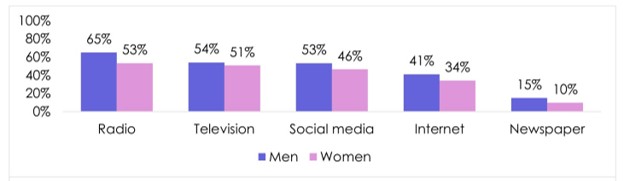
The findings also reveal a gender disparity in news consumption. Men are more likely than women to access news through radio, television, social media, the internet and newspapers.
Statistics according to the research reveal that at least 12 per cent more men access news on radio than men, the highest disparity on any medium, while television accounts for a four per cent gap.
This difference raises important questions for broadcasters and other information providers. While radio has a broad reach across society, the gender gap suggests that more attention may be required to understand the barriers affecting women’s access to news and information.
The figure below shows a bar chart on gender disparity in news consumption across 38 countries.
Urban-Rural Divide
Socio-economic and geographical factors also influence news consumption.
The findings indicate that people in urban areas are twice as likely as their rural counterparts to consume news stories across the major media platforms. This may be influenced by differences in education, income and access to technology.
However, the picture changes significantly when it comes to radio. Afrobarometer notes that there is no significant geographical effect on radio consumption. In fact, radio is the only medium regularly accessed by most rural residents, at 60 per cent.
This highlights the continuing importance of radio in reaching communities that may otherwise be excluded from the rapidly expanding digital information ecosystem.
What the Findings Mean for Zambia
The findings have particular significance for Zambia, where the Independent Broadcasting Authority (IBA) plays a central role in regulating the broadcasting sector and promoting a diverse, accessible and responsible broadcasting environment.
1. Potential for Investment in Radio
The IBA has licensed 203 radio stations across the country, including more than 100 community radio stations. This extensive radio network is significant given Afrobarometer’s finding that radio remains the most widely accessed source of news, particularly among rural communities and audiences with limited access to digital platforms. The findings therefore point to continued potential for investment in the radio sector, particularly in community broadcasting, content development, technology and innovative ways of reaching underserved audiences.
2. Platform for Dissemination of Information
For Zambia, the findings reinforce the important role of radio as a platform for disseminating news, public information and development messages, as well as providing opportunities for community engagement. Its accessibility makes radio particularly important for rural communities and audiences with limited access to digital platforms. At the same time, broadcasters can extend their reach by integrating radio with social media, online streaming and other digital platforms.
3. Role of the IBA
The findings also highlight the important role of the IBA in supporting a broadcasting environment where access to information is accompanied by responsible, credible and professional content. Through its regulatory and monitoring functions, the IBA contributes to promoting accuracy, fairness, balance and accountability while protecting the public interest. As the broadcasting sector continues to grow and diversify, effective regulation remains important in maintaining public confidence in broadcast content.
4. Potential for Investment in Audience Surveys in Zambia
Changing audience habits mean that broadcasters can no longer rely solely on traditional radio. Audiences are increasingly moving between radio, social media and online platforms, creating opportunities for broadcasters to extend their reach and engage new audiences. This changing environment also creates potential for investment in audience research in Zambia. Regular and credible audience surveys could help broadcasters, advertisers and regulators better understand audience preferences, listening patterns and the movement of audiences between traditional and digital platforms.
Such research would provide valuable evidence for programming, advertising, investment and regulatory decisions. It could also help identify emerging audience trends and inform the development of content that responds to changing consumer behaviour.
For Zambia, therefore, the opportunity is not to choose between radio and digital media, but to understand how the two can complement each other.
The findings ultimately demonstrate that radio remains an important source of information in Zambia, while also highlighting the need for the sector to evolve. The challenge is to ensure that radio continues to adapt to changing audience expectations while retaining its accessibility, relevance and role as a trusted source of information.
Leave a Reply